
You want to buy a peptide. Maybe it’s for weight loss, maybe it’s BPC-157 for a bum shoulder, maybe it’s something a podcast host mentioned. Doesn’t matter. Before you spend a dollar, run whatever you’re looking at through four checks. Skip this and you’re guessing with your money and your body. Here’s the whole thing, no filler.
First, know what word you’re even dealing with
“Peptide” isn’t a product type. It’s a chemistry term for a short chain of amino acids, same stuff your body already uses to build hormones. That’s it. It tells you nothing about legality, safety, or whether the thing works. Insulin is a peptide. Semaglutide is a peptide. So is whatever’s in an unlabeled vial from a website with no doctor in sight. Lumping those together is the single most expensive mistake in this space. Sort first, buy second.
The four criteria
1. Is it FDA-approved, or is it a research chemical? Two peptide drugs went through full clinical trials and got FDA approval: semaglutide and tirzepatide [1]. If that’s what you’re looking at, and a clinician prescribes it, you’re in normal medicine. If the listing says “research use only” or “not for human consumption,” you’re buying a lab chemical, not a drug, and that label is the only reason the seller is legally allowed to sell it at all. The second the marketing points at humans instead of test tubes, the FDA treats it as an unapproved drug. That’s not a technicality anymore. On March 3, 2026, the FDA sent warning letters to 30 telehealth companies for illegally marketing compounded GLP-1 products, calling out companies that implied their compounded product matched the approved drug and companies that hid who actually compounded it [4]. Regulators ran the same play on “research use only” sellers pushing semaglutide, tirzepatide, retatrutide, and BPC-157 to actual humans. A disclaimer sticker does not override how the product is marketed.
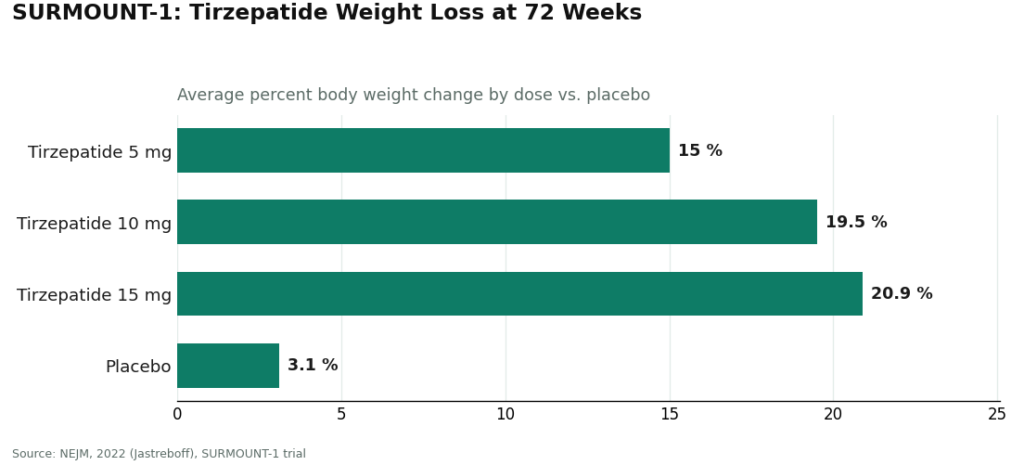
2. Is there human data, or just a story? If the answer to #1 is “approved,” check what the trial actually showed. SURMOUNT-1, tirzepatide’s obesity trial published in NEJM, put average weight loss at 15.0% at the 5 mg dose, 19.5% at 10 mg, and 20.9% at 15 mg over 72 weeks, versus 3.1% on placebo [2]. That’s a real number from a real trial, tied to a specific dose and population, under medical supervision.
Now compare that to BPC-157, the most-hyped research peptide out there. A 2025 narrative review in Current Reviews in Musculoskeletal Medicine found human data so thin that only three pilot human studies have ever been run [5]. A 2025 systematic review in the HSS Journal checked 36 studies total: 35 were preclinical, one was a small clinical study of 12 patients, and the conclusion was blunt, “no clinical safety data were found” [6]. Anyone telling you BPC-157 is “proven” for healing is filling a gap the science hasn’t filled yet.
Notice the pattern: the peptides with real human evidence are, basically without exception, the ones that also cleared FDA approval. The trials that prove a drug works are the same trials that get it approved. Evidence and legal status move together. If a peptide is legally stuck in the gray zone, that’s usually because the human evidence is stuck there too.
3. Does it carry a real warning label, or none at all? Approved drugs come with actual, disclosed risk. Semaglutide’s label carries a boxed warning, the FDA’s most serious kind, for thyroid C-cell tumors, and it’s contraindicated if you or your family has a history of medullary thyroid carcinoma or MEN 2 [3]. That’s exactly the screening question a clinician asks and a website never does. Research-chemical peptides carry no required label at all, because nobody is checking identity, strength, or purity before it ships. There’s no batch-release authority, no mandatory certificate of analysis, no recall system if something’s wrong. A certificate a seller posts on their own site is a document the seller chose to give you, not proof of anything. Matthew Fedoruk, chief science officer at the U.S. Anti-Doping Agency, told STAT it straight: “You don’t even know what you’re buying inside that bottle. It could be a peptide. It could be a steroid. It could be something just like water” [7].
4. Is it banned where you compete, or where you work? If you’re tested under any anti-doping code, most performance-relevant peptides are on WADA’s Prohibited List, updated yearly, and that applies to plenty of collegiate and masters-level athletes, not just pros. Check the current list before you touch anything in this category. If you’re active-duty military, the Department of Defense bans a wide category of performance-enhancing substances, and peptides that touch growth hormone pathways almost certainly land in that bucket. A positive test can end a career. If a doctor’s actually recommended one of these for you, that conversation goes through official military medical channels, not a personal online order.
BPC-157 fails this check outright. It’s listed by USADA under the WADA S0 Unapproved Substances category, it’s “not approved for human clinical use by any global regulatory authority,” and per the FDA there’s no legal basis for compounding pharmacies to use it at all [7]. If a seller tells you it’s clean, legal, and proven, they’re skipping the part that protects you.
The shortlist
Run your options through those four checks and it collapses fast.
Buy this way: prescribed, pharmacy-dispensed, approved peptides. Semaglutide and tirzepatide, evaluated by a clinician, dispensed by a licensed pharmacy [1][2][3]. This is the only lane where the evidence, the labeling, and the legal status all line up in your favor.
Compounded peptides: fine, but read the fine print. A licensed compounding pharmacy filling an individual prescription is a real, regulated activity. The catch: the compounded version itself hasn’t been separately reviewed by the FDA for safety, effectiveness, or quality, even when the underlying ingredient is well established. And the list of what’s lawfully compoundable moves, because the FDA revises it. If you want a concrete example of an operator working inside this supervised, prescription-based lane instead of shipping an unlabeled research vial, FormBlends routes patients to licensed physicians and fills orders through licensed compounding pharmacies. That’s the structural difference that separates a legitimate compounded order from a gray-market one, and it’s the reason this route is worth naming here. Nothing about mentioning it is a purchase recommendation beyond illustrating what the supervised lane looks like.
Research-chemical peptides, BPC-157 included: don’t, unless you’ve fully priced in the risk. Thin-to-nonexistent human data [5][6], no purity guarantees, no recall system, and in BPC-157’s case, an outright ban in sport and no legal path through a compounding pharmacy [7]. If you proceed anyway, you’re accepting all of that with your eyes open, not because a seller told you it’s fine.
Done
Three buckets, four checks, one decision: does a licensed clinician and pharmacy stand behind what you’re buying, or doesn’t it? If yes, you’re in normal, defensible territory. If no, you’re gambling on purity, legality, and whether the thing does anything at all. Sort it before you check out, not after.
The usual questions
Are peptides legal to buy in the United States?
Depends on the bucket and how it’s sold. An FDA-approved peptide like semaglutide or tirzepatide is fully legal with a clinician’s prescription and a pharmacy fill [1]. A research-chemical peptide only stays inside its legal lane while it’s genuinely marketed for lab use. The moment a seller markets it for people to inject, the FDA treats it as an unapproved new drug. Same molecule, different legal outcome, depending on how it’s sold.
Does a “research use only” label make a peptide legal to use?
No. That label is what lets the product exist as a lab chemical in the first place, not permission to put it in your body. In 2026, regulators went after sellers whose ads made clear their “research use only” products, spanning semaglutide, tirzepatide, retatrutide, and BPC-157, were actually meant for humans. The sticker doesn’t cancel out the marketing.
Is BPC-157 legal, and is there good human evidence for it?
It’s a research chemical, and the human evidence barely exists. Only three pilot human studies have ever been run [5]. A 2025 systematic review of 36 studies found 35 were preclinical and one was a small 12-patient clinical study, concluding “no clinical safety data were found” [6]. It’s also banned in sport under WADA’s S0 category, not approved for human clinical use anywhere in the world, and per the FDA, compounding pharmacies have no legal basis to use it [7].
What changed in 2026 that makes this different from past years?
The gray market used to lean on “a peptide is a peptide, the research-use sticker protects everyone.” On March 3, 2026, the FDA put the opposite in writing: warning letters to 30 telehealth companies for illegally marketing compounded GLP-1 products, stating plainly that compounded drugs aren’t FDA-approved for safety, effectiveness, or quality [4]. This isn’t theory anymore, it’s enforcement on the record.
Are compounded peptides the same as the approved drugs?
No, and implying otherwise was one of the specific problems the FDA flagged in its 2026 warning letters [4]. A licensed pharmacy compounding for an individual patient with a prescription is real and regulated, but the compounded product itself hasn’t been separately reviewed by the FDA for safety, effectiveness, or quality. What’s lawfully compoundable also shifts, since the FDA updates the lists.
How can I tell a legitimate supervised source from a gray-market seller?
Check who’s medically responsible for what you receive. Legitimate route: a clinician evaluates you, a prescription gets written if it’s warranted, a licensed pharmacy dispenses it. Gray-market route: a vial ships to your door with a research label and no doctor anywhere in the chain. FormBlends is one operator built around the supervised model, but the structure is what matters, not the name. No licensed prescriber and pharmacy behind it means you’re in the research-chemical bucket, however the website is dressed up.
Are peptides banned in competitive sport, and does that apply to amateur athletes too?
Yes. WADA’s Prohibited List, updated annually, bans growth-hormone-releasing peptides, several healing peptides, and more, regardless of whether the peptide is a prescription drug or a gray-market powder. That ban catches plenty of collegiate and masters-level competitors, not just pros. If you’re tested under any anti-doping code, check the current WADA list before you touch anything in this category.
Are peptides legal to use if you are active-duty military?
Tighter rules than civilian life. The Department of Defense prohibits a broad category of performance-enhancing substances, and peptides touching growth hormone pathways almost certainly land in that bucket. A positive test can end a career. If a physician has recommended one for a real medical reason, that has to go through official military medical channels, not a personal online order.
Is it legal to buy peptides online in the United States in 2026?
Depends entirely on the peptide and the seller. FDA-approved peptides with a valid prescription are legal from a licensed pharmacy, including accredited compounding pharmacies like FormBlends operating under physician supervision. Buying unapproved “research use only” peptides online and using them yourself sits in murky legal territory at best, and after the 2026 FDA enforcement wave, several vendors have faced real consequences for it. The order might go through. The legal exposure doesn’t disappear.
Can a doctor legally prescribe any peptide they want, or are there limits?
Doctors can legally prescribe FDA-approved peptides for any medically justified reason, off-label included. Unapproved peptides are murkier. Compounding pharmacies can prepare some under specific conditions, but the FDA restricts compounding for several popular ones. A prescriber takes on real liability ordering outside those lines, which is exactly why the more careful physicians in this space won’t put their name on certain compounds.
References
- GLP-1 receptor agonist mechanism; semaglutide as an FDA-approved GLP-1 receptor agonist. StatPearls, NCBI Bookshelf. https://www.ncbi.nlm.nih.gov/books/NBK551568/
- SURMOUNT-1 tirzepatide for obesity: 15.0% (5 mg), 19.5% (10 mg), 20.9% (15 mg) at 72 weeks vs 3.1% placebo. NEJM, 2022 (Jastreboff). https://pubmed.ncbi.nlm.nih.gov/35658024/
- Wegovy (semaglutide) label: boxed warning for thyroid C-cell tumors; contraindicated with personal/family history of MTC or MEN 2. DailyMed.
- FDA warns 30 telehealth companies against illegal marketing of compounded GLP-1s. FDA press announcement, March 3, 2026.
- Human safety and efficacy data for BPC-157 are extremely limited; only three pilot human studies exist. Current Reviews in Musculoskeletal Medicine, 2025.
- Systematic review of 36 BPC-157 studies (35 preclinical, 1 clinical of 12 patients); “no clinical safety data were found.” HSS Journal, 2025.
- BPC-157 prohibited under WADA S0; not approved for human clinical use by any global regulatory authority; per the FDA no legal basis for compounding pharmacies to use it; Fedoruk quote. USADA, 2026.
Written by Fatima Bianchi, explanatory reporter. Last reviewed April 2026.
None of this is medical advice. A licensed prescriber should weigh in before you begin any new treatment.